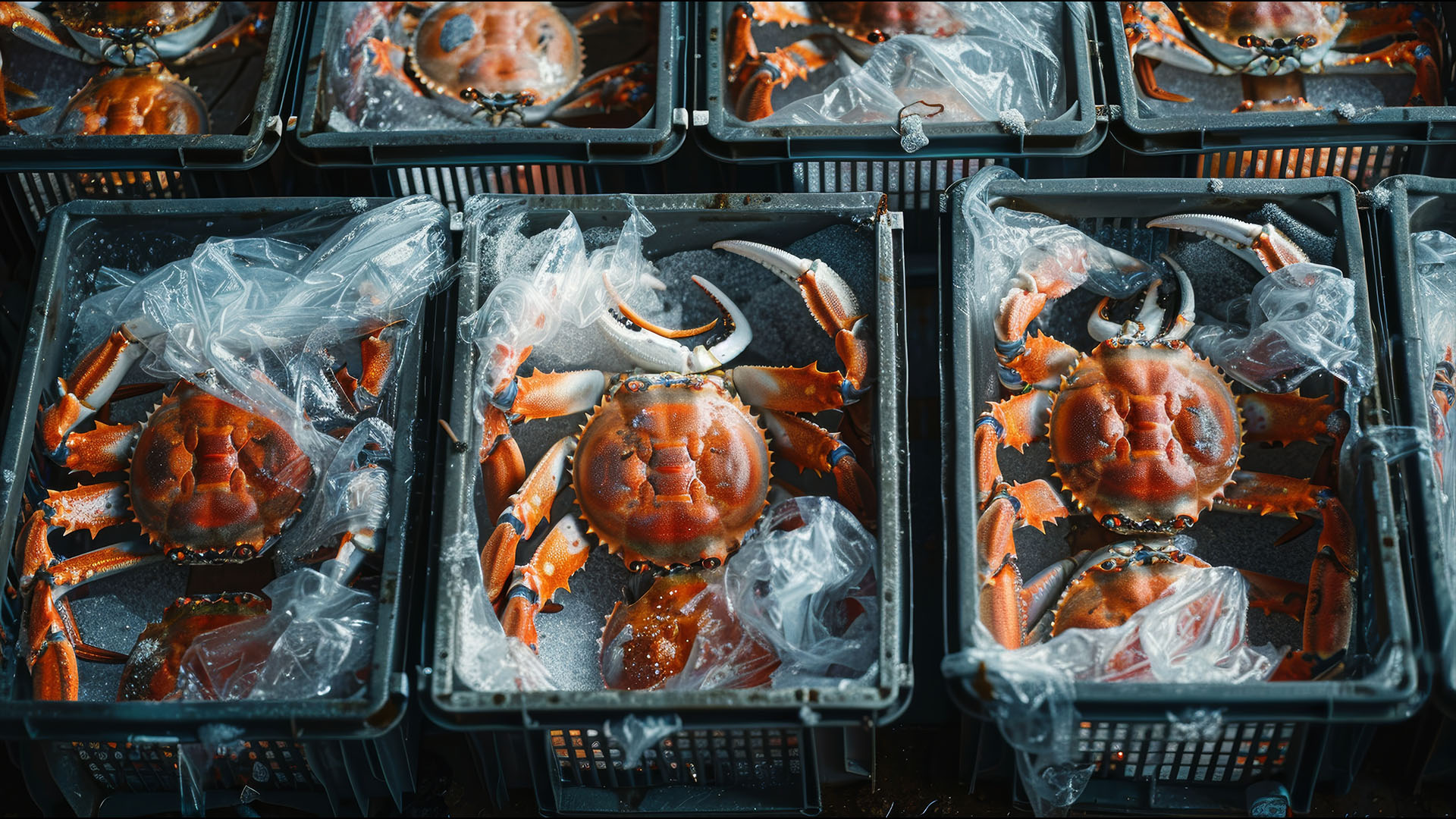
If you're eating seafood in the United States, there's a good chance it didn't start here. Nearly 80% of fresh and frozen seafood consumed domestically is imported.
To import seafood into the US, you have to navigate regulations across several federal agencies, each responsible for making sure products are safe, legal, and meet U.S. standards. Seafood shipments are highly vulnerable. More than one agency is often reviewing the same shipment at the same time, so you don't want any of your paperwork looking fishy. Even just one agency is all it takes to flag a container and get it held up at port.
This guide spells out what first-time importers need in order to build a seafood compliance program, and what experienced importers should be checking in their current setup.
The Agencies You'll Work With
Seafood imports are overseen by several federal agencies, and they don't always coordinate with each other. Knowing which agency is focused on what can save a lot of time at entry.
| Agency | What They Regulate | Key Programs |
|---|---|---|
| U.S. Food & Drug Administration (FDA) | Food safety, facility registration, Prior Notice | HACCP (Hazard Analysis Critical Control Point); FSMA (Food Safety Modernization Act); Imported Seafood Safety Program |
| National Marine Fisheries Service (NOAA Fisheries) | Trade monitoring, fisheries data, marine mammal protection | SIMP (Seafood Import Monitoring Program); IFTP (International Fisheries Trade Permit); MMPA Import Provisions (Marine Mammal Protection Act) |
| Customs & Border Protection (CBP) | Entry, classification, valuation, duty assessment | ACE filings (Automated Commercial Environment); HTS classification (Harmonized Tariff Schedule); AD/CVD enforcement (Antidumping and Countervailing Duties) |
| U.S. Fish and Wildlife Service (FWS) | CITES-listed (Convention on International Trade in Endangered Species of Wild Fauna and Flora), endangered species | Designated Port Exception Permits; CITES permits |
| Animal and Plant Health Inspection Service (APHIS) | Limited; breaded seafood with animal-origin breading, live fish | Veterinary Import Permits |
The first three agencies apply to almost every seafood entry. FWS comes into the picture when CITES-listed species are involved, such as sturgeon, certain coral, and some sharks. APHIS only comes up in rare, specific cases.
Before Anything Ships
Before anything leaves the supplier's warehouse, there are registrations to complete and permits to obtain. Many importers learn this the hard way, when their first container is held at port. Here are the requirements that can't be ignored:
- FDA Facility Registration: Any foreign facility that produces or handles seafood for the U.S. market must be registered with the FDA. The importer doesn't register; the facility does. Registration must be renewed every two years.
- Prior Notice: Every seafood shipment needs Prior Notice filed with the FDA before it arrives in the U.S. The filing is done electronically through ACE.
- International Fisheries Trade Permit (IFTP): If the seafood falls under the Seafood Import Monitoring Program, the importer of record needs an IFTP. Applications are handled through the NOAA Fisheries Permits system.
- FWS Designated Port Exception Permit (DPEP): If CITES-listed seafood is entering through a port that isn't designated by FWS, a DPEP is required. There is a $100 application fee for this permit.
- Customs Bond: Every commercial seafood entry needs a customs bond. It's standard across imports and part of clearing goods through CBP.
This is all something an experienced customs broker will sort out before the freight is even booked, not once the container is already in the water.
Seafood Import Monitoring Program (SIMP)
SIMP is where most new importers get caught off-guard. The program covers 13 priority seafood species groups and roughly 1,100 individual species identified as vulnerable "to combat illegal, unreported, and unregulated fishing or seafood fraud from entering U.S. commerce."
The 13 SIMP species groups are:
- Abalone
- Atlantic cod
- Blue crab (Atlantic and Gulf coasts)
- Dolphinfish (mahi-mahi)
- Grouper
- King crab (red)
- Pacific cod
- Red snapper
- Sea cucumber
- Sharks
- Shrimp
- Swordfish
- Tunas: albacore, bigeye, skipjack, yellowfin, and bluefin
For SIMP-covered entries, the importer of record must collect and report harvest event data, including vessel name, gear type, fishing area, harvest date, and ASFIS (Aquatic Sciences and Fisheries Information System) species code. The record must be maintained for two years. If any of the information is missing, the shipment will not clear.
Documents Required at Entry
| Document | Required by | Notes |
|---|---|---|
| CBP Form 3461 (Entry/Immediate Delivery) | CBP | For all commercial entries |
| CBP Form 7501 (Entry Summary) | CBP | Filed within 10 working days of cargo's release |
| Commercial invoice and packing list | CBP | Must include scientific species name, processing facility FDA registration number, and product detail (fresh, frozen, whole, fillet) |
| Bill of Lading or Air Waybill | CBP | Standard |
| NOAA Form 370 (Fisheries Certificate of Origin) | NOAA | Required for tuna and certain other species |
| IFTP Number | NOAA | SIMP-covered species only |
| FDA Prior Notice Confirmation | FDA | All food shipments |
Duty Exposure on Imported Seafood
Most fresh and frozen seafood imported into the U.S. under HTS Chapter 03 (fish or crustaceans, molluscs, and other aquatic invertebrates) enters at low or zero MFN (Most Favored Nation) rates, the tariffs countries promise to impose on imports from other members of the World Trade Organization. Prepared and preserved seafood under HTS Chapter 16, including canned tuna, prepared shrimp, and fish sticks, carries higher MFN rates.
For most importers, base duty rates are only part of the picture. The extra tariffs added on top are what drive up costs.
- Section 301 duties apply to seafood originating in China: tilapia, certain prepared shrimp, and other Chinese-origin products.
- Reciprocal tariffs apply to seafood from a wide range of countries, and they're often what's driving up duty costs today.
- Antidumping and Countervailing Duties (AD/CVD) are a major driver of duty costs for shrimp imports. There are active AD/CVD orders on warm water shrimp from Vietnam, India, Ecuador, Indonesia, China, and Thailand. Crawfish tail meat from China and Vietnamese pangasius are also subject to these duties. Depending on the producer, rates can range from low single digits to triple digits.
- Merchandise Processing Fee (MPF) and Harbor Maintenance Fee (HMF) are mandatory user fees applied to all entries by CBP. MPF is assessed as a percentage of cargo value with a per-entry cap; HMF runs at 0.125% of cargo value at most U.S. seaports.
What's Recoverable Through Drawback
A lot of importers don't realize this, but in certain situations, money paid on imports can come back later. When you import seafood into the US and then it leaves again, whether exported, used in a product that's exported, or even destroyed under CBP supervision, most of what was paid in duties, taxes, and fees can be recovered, often up to 99%.
For seafood importers, the opportunities tend to fall into a few common scenarios.
Recoverable through drawback:
- Ordinary MFN duties
- Section 301 duties
- Reciprocal tariff duties
- MPF and HMF
Not recoverable: AD/CVD on the AD/CVD HTS line.
If you're bringing in seafood from countries subject to reciprocal tariffs or Section 301, and that product later leaves the U.S., whether as-is or used in something else, there's often an opportunity to get a good portion of those duties back. CBP estimates that the majority of eligible drawback refunds go unclaimed each year. For a mid-sized seafood importer with steady reciprocal tariff exposure, that can easily reach six figures annually.
Most of the time, it isn't eligibility that's the problem. It's the paperwork. To file a drawback claim, you need a clean paper trail that connects the export back to the original import entry.
This is typically where a drawback specialist comes in. Having someone who deals with these filings regularly speeds things up and makes it far more likely the refund actually gets recovered.
Common Reasons Seafood Entries Get Held
Most seafood holds and refusals trace back to a few recurring issues:
- Incomplete SIMP data: Missing harvest event records, incorrect ASFIS codes, or vessel details that don't line up.
- HACCP issues at origin: If the foreign facility isn't operating under a valid HACCP plan, the FDA can refuse entry outright.
- Species misidentification: The scientific name on the invoice doesn't match the product. Most common with grouper, snapper, and tuna.
- Prior Notice errors: Late filings, incorrect shipment references, or missing fields.
- Cold chain documentation gaps: Temperature-controlled cargo arriving without the supporting records.
- MMPA "Certification of Admissibility" issues: If a fishery doesn't meet comparability requirements under the Marine Mammal Protection Act, a COA is required before it clears.
A broker who catches these issues before filing prevents a shipment hold. If they catch them after filing, you're already dealing with delays, cold chain integrity, storage costs, and extra fees on your invoice.
Working With a Customs Broker on Seafood Imports
Seafood happens to be one of the most regulated cargo categories in U.S. trade. The likelihood of something going wrong is much higher, especially across mixed species and origins. This guide has walked through what has to be handled before arrival, and it's a lot. If the effort isn't put in ahead of time, problems tend to surface at the port.
At Zarach Logistics, we've been handling customs entries for more than 40 years, and alongside that, we run our own drawback practice, so we're used to looking at where duties like Section 301 or MPF can be recovered when it applies. If you import seafood into the US and want a second set of eyes on your current setup, let us take a look and talk through how we can help.